1Department of Gastroenterology, Honor Health, Phoenix, Arizona, USA.
2Colon and Rectal Care Center of Phoenix, Arizona, USA.
Faisal Mehmood
Email: fmehmood@honorhealth.com
Received : Dec 12, 2024 Accepted : Jan 23, 2025 Published : Jan 30, 2025 Archived : www.meddiscoveries.org
Intussusception following a colonoscopy is a rare complication, potentially triggered by biopsies or polypectomies. The most common symptoms include abdominal pain, nausea, vomiting, hematochezia, and fever. A CT scan is the most sensitive diagnostic tool for detecting intussusception. While management is usually conservative, surgery may be required in rare instances. Only 13 cases of colo-colonic intussusception following colonoscopy have been reported, and among those, 4 needed a surgical intervention. We present a case of an elderly male who developed colo-colonic intussusception requiring a hemicolectomy after undergoing a colonoscopy with polypectomy.
Keywords: Colonoscopy; Polypectomy; Hematoma; Intussusception.
Intussusception is a condition in which a part of the intestine invaginates into the adjacent segment. The section that slides in is called the ‘intussusceptum’, and the part it slides into is called the ‘intussuscipiens’ [1]. It occurs more frequently in males than females, with a ratio of approximately 3:2. It is often a benign and spontaneous process in infants and toddlers that is typically treated successfully with enemas. In adults, it is relatively rare and often involves a ‘lead point’ - an abnormal area of the intestine that gets caught by the natural movement of the intestines and pulled into the neighboring section [1,2]. These lead points can be caused by polyps, cysts, tumors, vascular malformations, Meckel’s diverticulum, or lymphoid hyperplasia. Malignant conditions of the colon account for more than 50% of cases. However, approximately 8%–30% of all intussusception cases are classified as idiopathic [3,5].
Post-colonoscopy intussusception is extremely rare, occurring in less than 1% of cases [2,4]. Patients typically present with nonspecific gastrointestinal symptoms such as abdominal pain, nausea, vomiting, and bloody stools, accompanied by fever, signs of peritoneal irritation, and leukocytosis following colonoscopy [4]. A Computerized Tomography (CT) scan is the most sensitive diagnostic test. Surgery has been considered the standard treatment for intussusception in adults, as it often involves a lead point. However, cases without a physical lead point often resolve on their own with observation and antibiotics alone. Surgery is necessary if the patient develops acute illness or bowel ischemia. In certain situations where malignancy is unlikely, laparoscopy can be both diagnostic and therapeutic option [2,6]. We present a case of a 71-year-old male who had colo-colonic intussusception following a polypectomy during a colonoscopy requiring a right hemicolectomy.
A 71-year-old male presented to the emergency department with fever, chills, generalized abdominal pain, and hematochezia one day after colonoscopy. His medical history included ulcerative colitis. During the colonoscopy, he underwent a polypectomy, and a 19 mm polyp in the ascending colon was removed using a cold snare. He was discharged from the ambulatory surgical center without any immediate post-procedural complications.
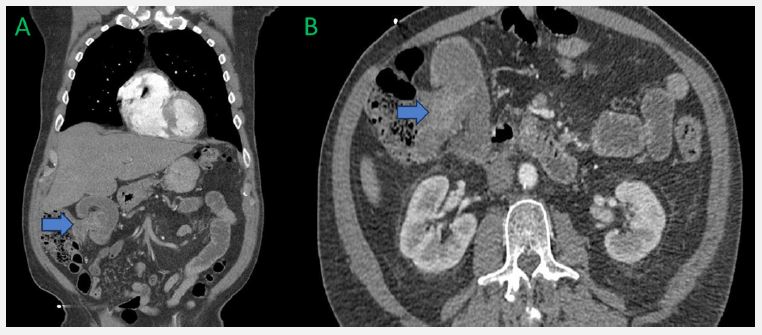
Later that day, he started having generalized abdominal pain with associated fever, chills, and hematochezia requiring an ED visit. On presentation, he was febrile to 102.2 F. Laboratory tests revealed leukocytosis to 20800 /uL, mild normocytic anemia with hemoglobin of 11.4 g/dL, normal platelet count, and INR. Blood chemistries showed hyponatremia (129 mmol/L), hypo kalemia (3.1 mmol/L), and normal lactic acid and liver tests. He underwent a CT of the abdomen & pelvis with IV contrast and was found to have a 6.5 × 6.8 cm hematoma in the hepatic flexure of the colon representing the recent polypectomy site with colo-colonic intussusception at the site of hematoma (Figures 1A & 1B). However, there was no evidence of perforation.
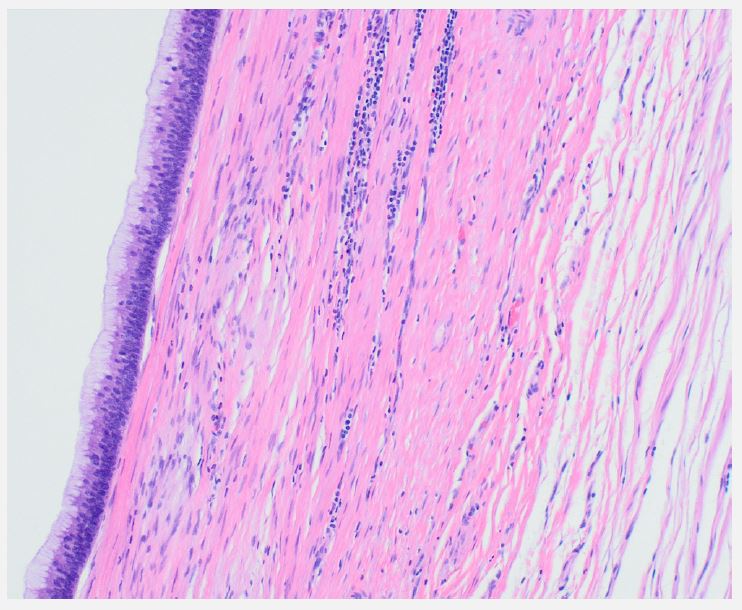
Colorectal surgery evaluated the patient and recommended initial conservative management, including IV hydration and broad-spectrum antibiotics. Later, the blood cultures grew E. coli and the patient had persistent abdominal pain. After a thorough discussion with the patient and family, a right hemicolectomy was performed, which he tolerated well without post-operative complications. He recovered well and was discharged home. Follow-up visits confirmed his continued improvement. Pathology of the resected right colon showed mucosal and submucosal necrosis with marked neutrophilic exudate extending into muscularis propria suggestive of intussusception (Figure 2).
Intussusception following an endoscopic procedure is exceedingly rare, with only a handful of cases reported. The majority of the cases involved the resection of lesions in the colonic mucosa, including biopsies and polypectomies. The subsequent intussusception was attributed to bowel edema acting as a lead point [7]. There are other theories explaining the reasons for intussusception after colonoscopy. One theory suggests that the bowel may experience hyperperistalsis as it tries to expel the insufflated air, potentially creating a vacuum effect during the removal of the colonoscope and simultaneous gas aspiraaspiration [5,8]. This case is unique because the patient had a hematoma in the colon after polypectomy, which likely served as a trigger point. To our knowledge, no other documented cases in the literature have involved a hematoma as a trigger point. This finding suggests a new theory that a hematoma resulting from polypectomy may act as a trigger point for intussusception.
The first case of intussusception following a colonoscopy was described by Yamazaki et al in 2000 [8]. A recent study by Ligato et al. reported 19 cases of intussusception, of which 13 were classified as colo-colonic intussusception. Among these, four cases were managed conservatively, five required reductions via laparoscopy or colonoscopy, and four necessitated surgical intervention [2-15]. Although adult intussusception typically requires surgery, post-colonoscopy cases may occasionally resolve without intervention due to the absence of a pathological lead point [9]. However, conservative management may fail if symptoms worsen, requiring surgical intervention like laparoscopic reduction or surgery. Bowel resection is recommended in cases with suspected malignancy or bowel ischemia, while a laparoscopic approach can be both diagnostic and therapeutic in non-malignant cases [2]. This case contributes to the limited documentation of colo-colonic intussusception cases following colonoscopy, being the fifth reported case requiring surgical intervention. It highlights the importance of conservative management for non-malignant cases and the need to reserve surgery for cases with worsening symptoms or suspected malignancy.
Potential competing interests: The authors have reported that they have no relationships relevant to the contents of this paper to disclose.
Financial support: The authors report no funding.
Ethical consideration: Patient consent was obtained before submitting the case.