1Faculty of Chemical-Biological Sciences, Autonomous University of Guerrero, Mexico.
2Faculty of Agricultural and Environmental Sciences, Autonomous University of Guerrero, Mexico.
3Faculty of Natural Sciences, Autonomous University of Guerrero, Mexico.
Roxana Reyes-Ríos
Email: rreyes@uagro.mx
Received : Mar 15, 2025 Accepted : Apr 07, 2025 Published : Apr 14, 2025 Archived : www.meddiscoveries.org
The purpose of this research is to characterize the antibacterial and antioxidant activity of medicinal plant extracts and compare their biological activity with reported plant extracts. The study involved an in vitro evaluation of the antibacterial activity of the extracts against Escherichia coli, Salmonella enteritidis, and Shigella dysenteriae. Additionally, the antioxidant activity was determined using the DPPH method. Extracts from oregano, mint, thyme, lemongrass, sierrecilla, and tecomaxuchitl exhibited antibacterial activity at concentrations of 0.114, 0.456, and 0.912 μg/μL for Escherichia coli, Shigella dysenteriae, and Salmonella enteritidis. For antioxidant activity, oregano (79.88%) and sierrecilla (77.96%) demonstrated high antioxidant potential.
Keywords: Antioxidant activity; Antibacterial activity; Plant extracts; Enterobacteria.
Acute diarrheal diseases are a global public health issue and represent the third leading cause of death in children under the age of 5 [1]. While these diseases have various causes, the Enterobacteriaceae family is highly associated with these conditions.
This family is the largest and most heterogeneous group of Gram-Negative Bacilli (GNB) with clinical importance. They cause a wide range of diseases in humans, including gastrointestinal infections and opportunistic enterobacteria, such as Salmonella enterica, Shigella spp., Yersinia spp., and certain strains of Escherichia coli [2].
Various studies have highlighted the high prevalence of these bacteria and their resistance to different antimicrobials. This has prompted the search for alternative treatments, turning attention to medicinal plants.
Since ancient times, plants have been an essential source for alleviating diseases. In Mexico, the use of medicinal plants is deeply ingrained in its culture. Recently, this practice has regained importance in the treatment and prevention of diseases [3,4].
The leaves of eight medicinal plants (oregano, mint, thyme, lemon, lemongrass, the bark of cuachalalate, tecomaxuchitl, and sierrecilla) were collected in the community of Atenxoxola in the municipality of Chilapa de Álvarez and in the municipal seat of San Luis Acatlán in the state of Guerrero, Mexico, except for sierrecilla, which was collected in the municipality of Axutla in the state of Puebla. After collection, the material was transported to the Laboratory of Integral Food and Natural Product Production to carry out preliminary tests at UAGro. For the selection of plant material, and showing spots, burns, or tissue damage caused by fungi or bacteria were discarded.
Sample processing
The material was washed with distilled water and dried at room temperature on racks to facilitate ventilation, ensuring proper drying and avoiding material loss.
Determination of antibacterial activity
The antibacterial activity of the plant extracts was evaluated using the Kirby-Bauer method against the strains: Salmonella enteritidis, Shigella dysenteriae, and Escherichia coli provided by the Microbiology Laboratory of the Faculty of Chemical and Biological Sciences, UAGro.
Subsequently, bacterial suspensions were prepared in a 5% saline solution with equivalent turbidity.
500 mL of Müller-Hinton agar was prepared in Petri dishes. The bacteria were seeded after adjusting the bacterial suspension to 0.5 on the McFarland scale. The dishes were then incubated at 35±2oC for 24 h, and the effect was determined by measuring the inhibition halos of bacterial growth.
0.1140 g of each crude extract was resuspended in 2 mL of ethanol in test tubes, resulting in all extracts having a concentration of 0.057 mg/mL. Subsequently, sterile paper discs were prepared with 2, 8, and 16 μL, yielding 0.114, 0.456, and 0.912 μg/μL of crude extract per disc. The discs were dried in a Petri dish and then placed in the culture media. The positive control was a 30 μg gentamicin disc, and the negative control was a disc with 3 μL of distilled water.
Determination of antioxidant activity
The antioxidant activity of the medicinal plant extracts in this study was determined using the DPPH (1,1-diphenyl-2-picrylhydrazyl) method.
0.5 μL of each extract was diluted to 2 mL with DPPH, with three repetitions for each extract. All reactions were incubated for 2 hours at room temperature in light-protected test tubes, and absorbance was measured at 520 nm using a spectrophotometer.
The results were expressed as IC50 inhibitory concentration (in mg/mL), indicating the amount of substance in 1 mL of reaction required to reduce the initial DPPH concentration by 50%.
Antibacterial activity
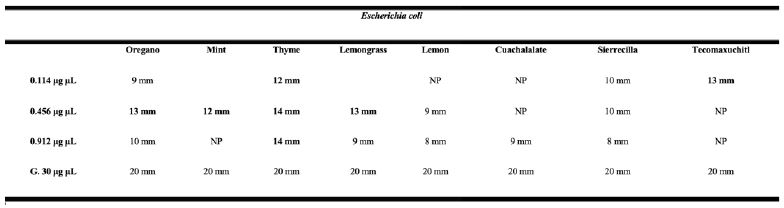
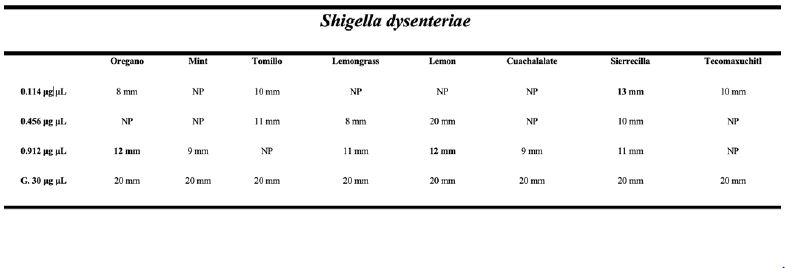
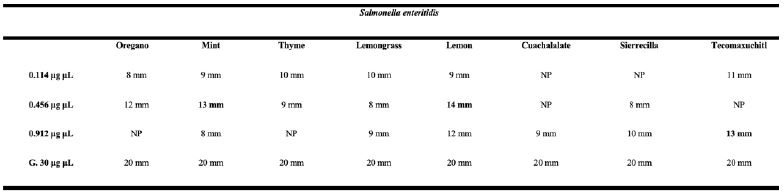
The results of the antibacterial activity of the extracts at concentrations of 0.114 μg/μL showed variability in the ability to inhibit bacterial growth for each extract. Mint, thyme, lemongrass, and tecomaxuchitl inhibited Escherichia coli, while sierrecilla inhibited Shigella dysenteriae. Some extracts showed minimal activity, while others showed no activity.
Regarding the antibacterial activity of the extracts at concentrations of 0.456 μg/μL, variability in bacterial growth inhibition was observed for each extract. Oregano, thyme, and lemongrass inhibited Escherichia coli, while lemon showed better inhibition for Shigella dysenteriae. For Salmonella enteritidis, only mint and lemon showed inhibition. Some extracts showed minimal activity, while others showed no inhibitory activity
At concentrations of 0.912 μg/μL, variability in bacterial growth inhibition was also observed for each extract. Thyme inhibited Escherichia coli, while oregano and lemon showed better inhibition for Shigella dysenteriae. For Salmonella enteritidis, only tecomaxuchitl showed inhibition. Some extracts showed minimal activity, while others showed no inhibitory activity (Tables 1-3).
Antioxidant activity
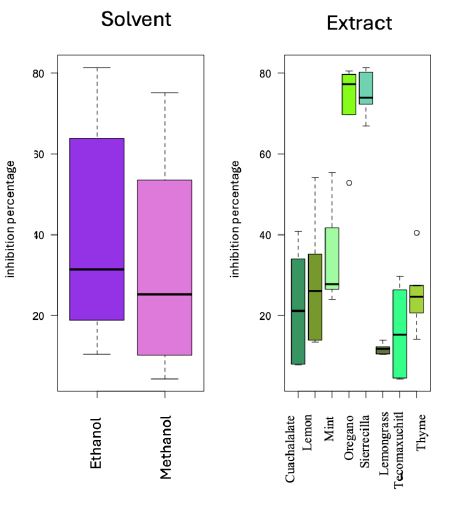
For the variable inhibition percentage, the means, variances, and graphs are presented for each of the factors studied and for the treatments.
The means (variances) of the inhibition percentage for plant extracts with different solvents were: Ethanol 39.67 (657.87) and Methanol 31.51 (633.54).
Antibacterial activity
For antibacterial activity, the most notable inhibition at a concentration of 0.114 μg/μL is observed in E. coli, with the tecomaxuchitl extract showing a 13 mm inhibition halo, and the extracts of mint, thyme, and lemongrass each showing a 12 mm halo. No effect was observed for the lemon and cuachalalate extracts at this concentration. At a concentration of 0.456 μg/μL, the extracts with the highest activity were thyme (14 mm), oregano, and lemongrass (13 mm), while cuachalalate and tecomaxuchitl showed no activity. At a concentration of 0.912 μg/μL, the most prominent extract was thyme with a 14 mm inhibition halo, while mint and tecomaxuchitl showed no activity.
For S. dysenteriae at a concentration of 0.114 μg/μL, the most active extract was sierrecilla (13 mm), while lemon, mint, lemongrass, and cuachalalate showed no activity. At a concentration of 0.456 μg/μL, lemon showed high activity with a 20 mm inhibition halo, while oregano, mint, cuachalalate, and tecomaxuchitl showed no inhibition. At a concentration of 0.912 μg/μL, the most active extracts were oregano and lemon (12 mm), while thyme and tecomaxuchitl showed no activity.
For S. enteritidis, at the first concentration of 0.114 μg/μL, the most significant inhibition was observed with the tecomaxuchitl extract, while cuachalalate and sierrecilla showed no inhibition. At a concentration of 0.456 μg/μL, the inhibition was greatest for lemon (14 mm), mint (13 mm), and oregano (12 mm), while cuachalalate and tecomaxuchitl showed no activity. Finally, at a concentration of 0.912 μg/μL, the most prominent activity was observed with tecomaxuchitl (13 mm) and lemon (12 mm), while oregano and thyme showed no activity.
Studies conducted by Naik, MI (2010), Băicuș, A (2022), Afrin A (2023), demonstrate that cuachalalate, oregano, thyme, mint, lemon, and lemongrass, as reported by their respective authors, indeed exhibit antibacterial effects [5-7]. Based on the results, it is observed that the antibacterial activity of the extracts at different concentrations increases as the concentration of the extract increases. It should be noted that for tecomaxuchitl and sierrecilla, due to the lack of more concrete identification, our results cannot be refuted, as their uses are primarily empirical.
However, it is noteworthy that some extracts exhibit antimicrobial dose-dependent and the influence of the solvent on the extraction of metabolites required for antibacterial activity, therefore, the availability of crude plant extracts depends on the type of solvent used for extraction and the concentration of the plant material [8].
Antioxidant activity
Several studies have shown that oregano, mint and lemon have a good antioxidant capacity.
In the antioxidant activity, the inhibition percentage variable presents the means and variances for each of the factors studied and treatments, namely solvents (Ethanol and Methanol), extracts (Oregano, Mint, Thyme, Lemongrass, Lemon, Cuachalalate, Sierrecilla, and Tecomaxuchitl), and Solvent-Extract combinations (EtOr, EtSi, MeSi, MeOr, MeLi, EtMe, EtCu, EtTo, EtTe, MeMe, MeTo, EtLi, MeTl, EtTl, MeCu, MeTe).
It is worth noting that for the distribution of the inhibition percentage, Ethanol has a mean of 39.67%, while Methanol has a mean of 31.51%. Based on this result, Ethanol was chosen for further use as it is industrially produced, commercially available, residual, and non-toxic to health. Thus, it was used for the development or resuspension of the extract and for carrying out antibacterial activity tests.
Regarding extract effectiveness, oregano and sierrecilla stand out. Although Ethanol was confirmed as the solvent to be used for the study, Methanol was also employed to compare its efficacy.
Extracts from oregano, mint, thyme, lemongrass, sierrecilla, and tecomaxuchitl exhibited antibacterial activity at several concentrations for Escherichia coli, Shigella dysenteriae, and Salmonella enteritidis.