Department of Surgery, Division of General Surgery, University of Montreal, Montreal, QC, Canada.
Giancarlo Sticca
Email: giancarlo.sticca@umontreal.ca
Received : Oct 06, 2025 Accepted : Nov 20, 2025 Published : Nov 27, 2025 Archived : www.meddiscoveries.org
Introduction: Online career orientation tools have become increasingly popular to aid medical students navigate speciality selection during the match process. However, there is a scarcity of publications regarding the impact, effectiveness and satisfaction associated with these medical career-counseling websites. The primary objective of this study was to evaluate the impact of a bilingual online career orientation tool on medical students’ understanding of medical specialties and on their career decision-making process.
Method: Between September 2020 and September 2023, the authors surveyed 121 medical students before and after consulting an online career orientation tool. The survey included 5-point Likert scales, multiple-choice questions and open-ended questions.
Results: The tool significantly increased students’ understanding of their specialty of interest and allowed them to learn valuable information that helped them make more informed career decisions. Medical students stated that being able to ask questions directly and anonymously to doctors was important for their career orientation. 71.1% claimed their vision of the specialty was ‘clearer’ or ‘much clearer’ after consulting the website. 87.6% stated that a lack of such a tool could lead to an incomplete understanding of their specialty of interest and suboptimal career choice. Questions which provided insight into doctors’ abilities and personality were most helpful for career orientation.
Conclusion: Medical students gained a deeper understanding of their specialty of interest and felt more confident and informed to make decisions regarding their career. This study serves as a needs assessment and points to future areas of study and quality improvement.
Medical students face the daunting task of selecting a specialty in their third year of medical school, a crucial decision for their future career trajectory. This challenge is compounded by the difficulty of gaining a comprehensive understanding of the various medical disciplines as a student.
Recent studies underscore the complexities of career decision-making in medical education, highlighting factors such as personal and professional life considerations, passion for specific specialties, and the influence of mentorship on specialty choice [1,2]. Authors such as Lily N. Trinh have demonstrated that gender-specific challenges play a critical role in career decisions among medical students [3]. Moreover, research has underlined the significance of aligning career guidance with medical students’ values and aspirations [4,5]. Various tools are available to aid in this decision-making process, including mentorship programs, observership opportunities, and online career orientation tools like the Association of American Medical College’s (AAMC’s) Careers in Medicine (CiM) tool or the Canadian Medical Association’s (CMA’s) Physician Specialty Profiles. These websites offer medical students valuable, recent, and easily accessible information to help them make more informed decisions about their future careers [6].
Despite the wide range of resources available online, there is a notable gap in the literature about their impact and effectiveness and students’ satisfaction with these resources [6,7], especially in medical schools where the language of instruction is French [7]. This study addresses this gap and adds to the literature by evaluating medical students’ perspectives and satisfaction associated with a new bilingual, online career orientation tool. The study provides a fresh perspective and narrows the research gap about these online career orientation tools for medical students [6,7]. Moreover, to our knowledge, this is the first completely bilingual tool available online for medical student career orientation. This further motivated the research group to evaluate its impact on career decision-making.
tion tool. The study provides a fresh perspective and narrows the research gap about these online career orientation tools for medical students [6,7]. Moreover, to our knowledge, this is the first completely bilingual tool available online for medical student career orientation. This further motivated the research group to evaluate its impact on career decision-making.
Study design and participant population
This single-institution study was performed at the Department of Medicine and Health Sciences at the University of Sherbrooke, located in Sherbrooke, Canada, between September 2020 and September 2023. The department dean supported our study, highlighting its institutional significance and alignment with educational goals. All medical students at the University of Sherbrooke in the study period were eligible participants. The students were identified using a search of the departmental electronic database, ensuring a complete and unbiased sample. An initial cohort of 800 students were then contacted by email, asking them to participate in the study. From the students who were contacted, 250 responded to the email and participated in the study.
Ethical and safety considerations
Participants were treated appropriately, and informed consent was obtained from every participant to verify their intent to participate and their understanding that the results would be published. Since participants had to send in questions or complete a survey, they were subjected to minimal risk. The selection of participants was equitable because all the medical students at the University of Sherbrooke were given an equal opportunity to participate in the study.
Adequate procedures were in place to ensure the privacy and confidentiality of participants. Throughout the survey study, participant confidentiality and anonymity were strictly upheld to guarantee ethical compliance. No personally identifying information was associated with any of the survey’s replies; all data were gathered anonymously. To further ensure that individual identities could not be identified, data was arranged and analyzed using unique participant codes. Only authorized members of the research team, who were subject to confidentiality agreements, had access to the raw data. Furthermore, the survey platform ensured that replies were transmitted and stored securely. Because all results were presented collectively, it was impossible to identify any specific individual. These steps maintained the integrity of the study and protected the participants’ privacy.
The data was collected and monitored safely without subjecting the participants to any risk or breach of confidentiality. Informed consent was obtained by informing the participants that their answers would be collected anonymously and used to evaluate the website’s impact in the context of a research project. A qualified outside party with a robust background in ethics scrutinized and confirmed the ethical considerations of the study. In summary, the work was carried out in accordance with the Declaration of Helsinki, which requires a guarantee of anonymity for the participants and their informed consent.
Data collection
Through an anonymized and password-protected Google document, participants selected a specialty of interest (e.g., family medicine, internal medicine, general surgery) and submitted any questions regarding that specialty. Students were prompted to ask any question they believed would offer insight or aid with their career orientation and choice of residency program.
The responses were then aggregated and analyzed for common themes. Duplicate questions were also removed. The specialty-specific questions were then reviewed by three corresponding specialists. For example, all the questions about the specialty of cardiology were sent to three cardiologists. Specialists were chosen based on their expertise, experience, and willingness to participate in this educational initiative. The questions were sent via email, and physicians were given a month to respond. The research team then translated the questions and answers and made them available in both English and French.
Next, a website called ZoneVerteMD was created to display the students’ questions and specialists’ responses, accessible in both English and French. This bilingual approach ensured accessibility and inclusivity, reflecting the diverse linguistic backgrounds of the student body. The website displayed 29 different web pages, one for each specialty that received questions. Each web page displayed the medical students’ questions and the specialists’ subsequent responses. Each bullet point under any select question represented a different physician’s response. A domain name was then chosen, and the website was published on the internet. It is accessible to all via the following link: https://www.zonevertemd.com/en. A tracking tool monitored the website’s usage, collecting data on the number of visitors, session duration, and page views. This tracking tool provided quantitative measures of the tool’s engagement and reach.
The research team chose to evaluate the impact of the online tool through an online survey because it allowed for versatility, anonymity, and accessibility. Survey questions were designed according to the Association for Medical Education in Europe’s guide for developing questionnaires [8]. The research team conducted a literature review, carried out a focus group on the subject, and then synthesized the information. Next, an expert faculty member specializing in ethics and medical education formulated the questions and collected feedback. Finally, a small subgroup of 10 students were asked to take the survey so that the research team could ensure they were responding to the items as intended. The survey was then administered to medical students before and after consulting the website to evaluate the impact of the online tool on students’ understanding of medical specialties and their career decision-making process. For the main part of the study, students were recruited on a voluntary basis through a secondary email. In this case, 121 out of 800 students chose to participate, yielding a participation rate of 12.5%. The survey method and the crafted questions tied into the research objectives of the project because they allowed the research team to gain insight into the perception of such a tool before and after consultation so that its impact could be evaluated.
The 121 medical students who chose to participate were prompted to select their field of interest from three broad categories: medical, surgical, or diagnostic. The medical category included family medicine, internal medicine, pediatrics, and dermatology. The surgical category included general surgery, neurosurgery, obstetrics and gynecology, orthopedic surgery, otolaryngology, vascular surgery, cardiothoracic surgery, urology, cardiac surgery, and plastic surgery. Finally, the diagnostic category included radiology and pathology. This classification allowed for a detailed analysis of the students’ preferences and perceptions across a wide range of fields of interest. The survey included both Likert-scale items and open-ended questions, allowing for a nuanced analysis of the tool’s effectiveness.
Outcome measures, variables, and data extraction
The primary aim of this study was to evaluate whether an online career orientation tool deepens medical students’ understanding of their specialty of interest and helps with career orientation. An online website tracking tool recorded data about the website’s usage. This included metrics such as the total number of unique visitors since the website’s launch, total website sessions, geographical distribution of site sessions, and the specific number of unique visitors per specialty page. This quantitative data provided a foundation for assessing the tool’s reach and impact.
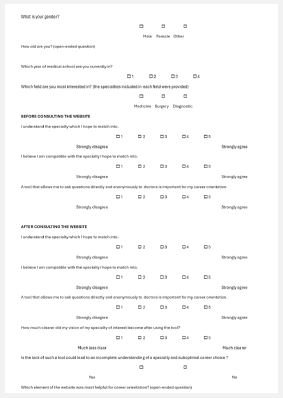
First, the data of the 121 survey respondents was collected. Demographic characteristics were noted. Then, survey respondents were asked to assess their level of agreement with specific statements before and after consulting the website. The agreement scores were based on a 5-point Likert scale, defined as follows: (1) strongly disagree, (2) disagree, (3) neither agree nor disagree, (4) agree, (5) strongly agree. The results were compared for the medical, surgical, and diagnostic specialties to see if there was a statistically significant difference among the groups. Additionally, information was also collected about the overall gain in understanding of the specialty and the impact of not having access to such a tool. Survey respondents were invited to share feedback on which aspects of the website they found most beneficial for career orientation. The responses were then organized into seven distinct themes: insights about the doctors’ abilities and personalities, lifestyle/work-life balance, work environment, matching into a specialty, salary, hidden curriculum, and tasks/responsibilities. The survey is depicted below in (Figure 1).
Statistical analysis
The data was recorded in an ExcelTM spreadsheet and processed using SPSSTM statistical software (Version 27, SPSS Inc., Chicago, Illinois, USA). Analyses included the two-tailed paired t-test for continuous variables. Depending on the data, the results were presented either as a mean (standard deviation) or a total number with a percentage. The significance was set to a p-value of <0.05, adhering to conventional criteria for statistical relevance.
Once the website was published, the online tracking tool recorded several data points about its usage. The website attracted a total of 1708 unique visitors and recorded 2326 website sessions. Visitors from 52 different countries accessed the site. A total of 1796 (77.2%) visitors were from Canada, and 231 (9.9%) visitors were from France. The remaining 299 (12.8%) visitors were from other countries. The five specialty pages receiving the greatest number of unique visitors were family medicine, orthopedic surgery, internal medicine, pediatrics, and psychiatry. The five specialty pages receiving the least number of unique visitors were gastroenterology, microbiology, urology, pathology, and pneumology. The details are outlined in (Table 1).
| Specialty | Unique visitors | Site sessions |
|---|---|---|
| Family medicine | 281 | 319 |
| Orthopedic surgery | 275 | 309 |
| Internal medicine | 242 | 280 |
| Pediatrics | 142 | 167 |
| Psychiatry | 111 | 127 |
| Neurosurgery | 111 | 126 |
| Obstetrics and gynecology | 103 | 127 |
| Nephrology | 109 | 111 |
| Cardiology | 105 | 113 |
| General Surgery | 98 | 111 |
| Anesthesiology | 83 | 90 |
| Ophthalmology | 70 | 74 |
| Diagnostic Radiology | 61 | 77 |
| Dermatology | 66 | 71 |
| Neurology | 63 | 70 |
| Public health | 56 | 62 |
| Intensive care | 56 | 59 |
| Medical oncology | 53 | 68 |
| Nuclear medicine | 52 | 58 |
| Endocrinology | 52 | 55 |
| Rheumatology | 49 | 54 |
| Geriatric medicine | 48 | 49 |
| Otolaryngology | 47 | 51 |
| Immunology | 45 | 54 |
| Gastroenterology | 44 | 46 |
| Microbiology | 37 | 39 |
| Urology | 37 | 40 |
| Pathology | 36 | 41 |
| Pneumology | 29 | 31 |
Next, data was collected about the demographic characteristics of the 121 survey respondents. Of the respondents, 91(75.2%) were women, and 30(24.8%) were men. Thirty students (28.0%) were between 18 and 20 years old, 75 students (61.9%) were between 21 and 24 years old, and 12 students (9.9%) were between 25 and 29 years old. The distribution of medical students’ training years was relatively well spread out. Of the students, 23(19.0%) were first years, 31(25.6%) were second years, 38(31.4%) were third years, and 29(24.0%) were fourth years.
When the 121 students were asked about their primary specialty of interest, 74(61.2%) chose a medical specialty, 40 (33.1%) chose a surgical specialty, and 7(5.8%) chose a diagnostic specialty. The students’ level of agreement with the various statements before and after consultation of the tool, scored on a 5-point Likert scale, is shown in (Table 2). Results presented as ‘Mean±SD’. A two-tailed paired t-test was used in this analysis. The significance was set to a p-value of <0.05. The online career- orientation tool increased the mean score of statement agreement for all three statements across all specialties and overall (n=121). Overall, when comparing before and after consultation of the website, there was a statistically significant increase in students’ agreement with the statement “I understand the specialty which I hope to match into” (p=0.03). Furthermore, there was no statistically significant difference when the data was analyzed for medical (p=0.08), surgical (p=0.17), and diagnostic (p=0.77) subgroups individually.
| Statement | Time | Medical (n=74) | Surgical (n=40) | Diagnostic (n=7) | Overall (n=121) |
|---|---|---|---|---|---|
| I understand the specialty which hope to match into | Before | 3.39±0.873 | 3.48±0.751 | 3.57±0.976 | 3.43±0.835 |
| After | 3.64±0.836 | 3.73±0.847 | 3.71±0.756 | 3.67±0.831 | |
| P-value | 0.08 | 0.17 | 0.77 | 0.03 | |
| I believe i am compatible with the specialty i hope to match into | Before | 3.66±0.816 | 3.63±0.628 | 3.43±1.134 | 3.64±0.775 |
| After | 3.69±0.890 | 3.80±0.883 | 3.86±0.690 | 3.74±0.873 | |
| P-value | 0.83 | 0.31 | 0.41 | 0.34 | |
| A tool that allows me to ask questions directly and anonymously to doctors is important for my career orientation | Before | 3.18±0.956 | 3.18±0.874 | 3.29±1.113 | 3.18±0.931 |
| After | 3.53±0.910 | 3.68±0.859 | 3.57±0.976 | 3.58±0.892 | |
| P-value | 0.02 | 0.01 | 0.63 | <0.001 |
| Post-consultation questions | Medical (n=74) | Surgical (n=40) | Diagnostic (n=7) | Overall (n=121) |
|---|---|---|---|---|
| How much clearer did my vision of my specialty of interest become after using the tool? (expressed as % “clearer much clearer”) | 51/74 (68.9%) | 29/40 (72.5%) | 6/7 (85.7%) | 86/121 (71.1%) |
| The lack of such a tool would lead to an incomplete understanding of a specialty and suboptimal career (expressed as % of participants agreeing with the statement) | 66/74 (89.2%) | 34/40 (85%) | 6/7 (85.7%) | 106/121 (87.6%) |
| The tool allowed me to learn new and valuable information about the specialty and will help me make a more informed career decision (expressed as mean ± SD for agreement on a 5-point Likert scale) | 3.77 ± 0.786 | 3.85 ± 0.783 | 4.29 ± 1.048 | 3.86 ± 0.778 |
With regard to the respondents’ perceptions of the statement “I believe I am compatible with the specialty I hope to match into” before and after consulting the career orientation tool, there was no statistically significant change, neither overall (p=0.34) nor individually in the medical (p=0.82), surgical (p=0.31), or diagnostic (p=0.41) groups. Secondly, a statistically significant increase in agreement for the statement “A tool that allows me to ask questions directly and anonymously to doctors is important for my career orientation” was observed for the medical group (p=0.02), the surgical group (p=0.01), and overall (p<0.001). However, there was no difference in the diagnostic group (p=0.63). When the three specialties were compared, there were no statistically significant differences in statement agreement scores after consulting the online career orientation tool.
When asked how much clearer their perception of the specialty was after using the career orientation tool, 86(71.1%) survey respondents responded either “clearer” or “much clearer.” In a subsequent question, 106(87.6%) students stated that the lack of such a tool could lead to an incomplete understanding of their specialty of interest and a suboptimal career choice. When asked to state their level of agreement with the statement, “The tool allowed me to learn new and valuable information about the specialty and will help me make a more informed career decision,” the mean score was 3.86 (out of a 5-point Likert scale). (Table 3) outlines the data regarding the students’ appreciation of the online website in more detail.
At the end of the survey, all respondents were invited to share feedback on which aspects of the website they found most helpful for career orientation. After careful analysis, the answers were organized into one of seven categories. Some students did not respond to this question and were excluded from the calculations. Ten students did not respond in the medical group (n=74 - 10=64). Two students did not respond in the surgical group (n=40 - 2=38), and two students did not respond in the diagnostic group (n=7 - 2=5). Overall, 107 of the 121 students answered the question. Of the 107 students who responded, 60(56.1%) stated that questions that provided insight into the doctors’ abilities, personality, strengths, and weaknesses were most helpful for career orientation. Twenty-four (22.4%) survey respondents believed the questions and answers regarding lifestyle and work-life balance were most useful. (Table 4) describes the elements of the website that the students found most useful.
| Element of the website that was most helpful for career orientation (n, %) | Medical (n=64) | Surgical (n=38) | Diagnostic (n=5) | Overall (n=107) |
|---|---|---|---|---|
| Insight about doctor's abilities and personality | 35/64 (54.7%) | 24/38 (63.2%) | 1/5 (20.0%) | 60/107 (56.1%) |
| Lifestyle and work-life balance | 14/64 (21.9%) | 8/38 (21.1%) | 2/5 (40.0%) | 24/107 (22.4%) |
| Work environment | 6/64 (9.4%) | 0/38 (0%) | 2/5 (40.0%) | 8/107 (7.5%) |
| How to match into a specialty | 4/64 (6.3%) | 4/38 (10.5%) | 0/5 (0%) | 8/107 (7.5%) |
| Salary | 4/64 (6.3%) | 1/38 (2.6%) | 0/5 (0%) | 5/107 (4.8%) |
| Hidden curriculum | 1/64 (1.6%) | 1/38 (2.6%) | 0/5 (0%) | 2/107 (1.9%) |
| Tasks and responsibilities | 0/64 (0%) | 0/38 (0%) | 0/5 (0%) | 0/107 (0%) |
The success of the bilingual, online career orientation tool was demonstrated by its significant user engagement, with 2326 website sessions and 1708 unique visitors recorded during the study period. This sheds light on the palpable need for such a resource for medical students. As highlighted by Hogan et al., the pandemic catalyzed the shift toward online platforms and digital resources in medical education, underscoring the importance of accessible and comprehensive career orientation tools [9]. This context situates the tool’s success within the larger movement toward digitalization in medical education, aimed at addressing the evolving needs of students in a dynamically changing educational landscape. The demographic predominance of survey respondents (women under 24 years old) reflects current trends in medical education [5]. This tool’s focus on anonymity and direct engagement with professionals offers a unique avenue for students to explore the factors behind career choice without the fear of judgment. It also complements the findings of Trinh et al. regarding the importance of supportive environments in career decision-making processes among medical students [5].
This new career orientation tool increased the medical students’ knowledge and confidence in their career orientation. Because students significantly increased their understanding of their desired specialties and were able to use the tool anonymously, this tool appears to be a promising new method for students to engage in their career orientation. This is further validated by the broad appreciation shown across all surveyed specialties, demonstrating the tool’s universal applicability and relevance. However, the tool did not improve the students’ perceived level of compatibility with a certain specialty. This finding may be explained by the fact each medical student can choose to adapt or not adapt to a residency program’s culture, as explained in Luong’s work [10]. Thus, this may have given rise to heterogenous results in our population for this particular question.
The top five specialties consulted on the website were family medicine, orthopedic surgery, internal medicine, pediatrics, and psychiatry. This is similar to the data reported by the Canadian Resident Matching Service (CaRMS) for the 2023 match, which reported that the top five discipline choices of candidates were family medicine, internal medicine, anesthesiology, psychiatry, and pediatrics [11]. The patterns exhibited by the students consulting the online career orientation tool were similar to the patterns observed during the 2023 CaRMS applications. The five least-consulted disciplines on the website were gastroenterology, microbiology, urology, pathology, and pneumology. This was attributed to the fact that these specialties were either not entry-level specialties or because they simply did not elicit as much interest from the website’s viewers.
which reported that the top five discipline choices of candidates were family medicine, internal medicine, anesthesiology, psychiatry, and pediatrics [11]. The patterns exhibited by the students consulting the online career orientation tool were similar to the patterns observed during the 2023 CaRMS applications. The five least-consulted disciplines on the website were gastroenterology, microbiology, urology, pathology, and pneumology. This was attributed to the fact that these specialties were either not entry-level specialties or because they simply did not elicit as much interest from the website’s viewers.
Most survey respondents reported that their vision of their specialty was clearer, and the lack of such a tool could lead to an incomplete understanding of their specialty of interest and a suboptimal career choice. The students also felt they had learned new and valuable information about the specialty that would help them make more informed career decisions. This suggests the students felt they had acquired novel information about medical specialties through the website and gained knowledge they would not have been able to acquire through more conventional methods, such as mentorships and observer ship opportunities.
The Canadian Medical Association Journal published an article regarding the impact of Future MD, a website that provides information to medical students, residents, and international students on the realities of medicine [12]. The tool allowed access to a wide range of data and left attending doctors wishing they had similar resources when they were in medical school [12]. Whereas Future MD focuses more on objective data, one of the advantages of ZoneVerteMD is that it allows a deeper dive into the realities of medical practice in Canada. However, Future MD has the advantage of tailoring the information to premedical students, medical students, and residents [12]. In contrast, ZoneVerteMD focuses solely on medical students applying for residency. Moreover, it should be mentioned that the reduced clinical exposure during the COVID-19 pandemic may have caused the online tool to be an even more useful source of information because many internships were canceled or modified to respect the rules of various medical and surgical departments.
The website highlights the doctors’ day-to-day schedule, responsibilities, salary, and work-life balance. This type of information is similar to other online career orientation tools, such as the AAMC’s CiM tool or the CMA’s Physician Specialty Profiles tool. However, the career orientation tool described in this article also discusses doctors’ triumphs and failures throughout their careers, professional opportunities in their fields, traits they believe helped them excel, and what they would do differently. Doctors also shared their experiences in medical school, the pros and cons of their specialties, their strengths and weaknesses, how they organize their days, what stresses them, and their best piece of advice to young students. Typically, this information can only be acquired through “dead time” during a rotation, a mentorship, or an established external connection. Unfortunately, due to the busy nature of the medical profession and disparities in opportunities among students, it is difficult to gain access to these types of insights. In an effort to respond to this challenge, the online career orientation tool centralizes a broad spectrum of useful, authentic, and easily accessible information that responds to medical students’ specific needs. Stagg et al. showcased the significant influence of preceptorships on medical students’ career choices, highlighting the importance of mentorship and quality teaching in shaping students’ career trajectories [2]. The research team believes that the online tool in this study facilitated a parallel dynamic through direct engagement and quality information, offering a digital mentorship experience that mirrors the positive educational influences of high-quality preceptor-student interactions.
When asked what elements of the website they found most helpful, most respondents reported that insight about the doctors’ abilities and personality were most helpful for career orientation. This is similar to what has been reported in the literature. In fact, over 50% of students choose specialties because they believe their capabilities match those of the specialty’s doctors [13]. In 2023, the AAMC reported that 98.2% of students believed that a student’s personality had a moderate or strong influence on their specialty choice [14]. Medical students want to be informed about the challenges, rewards, and working conditions of their specialty of interest [4]. These findings are rooted in the theory that personality plays an increasingly larger role in career decision-making. Program directors are now placing an increasing emphasis on subjective criteria rather than the traditional, quantitative, and objective metrics [15]. Career decisions seem to be influenced by similarities in strengths, abilities, and personalities between students and experts. Because students chose careers by matching their personality traits to the doctors’ personality traits, the career orientation tool was useful as it showcased the overarching characteristics of doctors.
The students stated that a tool that allows them to anonymously ask questions to doctors was important for their career orientation. Medicine can sometimes be unforgiving toward medical students. Smith et al. described situations where medical students are punished for being vulnerable, fear embarrassment from preceptors, and live in a culture of fear, which prevents adequate learning [16]. This could prevent medical students from having open and honest exchanges with doctors. The career orientation tool circumvents this obstacle by allowing students to express themselves anonymously and ask any questions they believe would best help them make a more informed career decision. This communication safe space helped the students who asked questions, but it also helped those who subsequently consulted the website in search of authentic information. The anonymity of this career orientation tool bears some resemblance to the Ask the Experts feature of the Vanderbilt CiM program, which allows students to anonymously ask physicians questions with the goal of encouraging open dialogue between students and experts [14]. The University of Sherbrooke’s career orientation tool has a similar objective: to help students gain a comprehensive, honest, and multifaceted understanding of the journey toward their specialty of interest.
There are several limitations to this study. The study’s reliability and generalizability may be impacted by a number of issues. First, because this was a single-center study, sample bias may have affected the outcomes, which could restrict how broadly or diversely the findings can be applied. In other words, the single-center nature of the study limits the quality of the data collection and generalizability of the results to other institutions, highlighting a potential sampling bias. Moreover, the lack of notable research evaluating the impact of online career orientation tools did not allow the researchers to compare and contrast their work. Furthermore, students were not questioned about their previous experiences and opinions of other career orientation tools or faculty-offered services. This prevents drawing definitive conclusions about the impact of the ZoneVerteMD website compared to the other available resources. There was also information bias because the accuracy of the information provided on the website and the respondents’ interpretations could vary, affecting their responses and the overall effectiveness of the tool. Furthermore, there was selection bias because the voluntary nature of participation may have attracted students who were already more proactive or interested in career planning, potentially skewing the results. Another limitation was the lack of a formal ethical approval process. However, this was addressed by treating the participants appropriately, not exposing them to unnecessary risk, ensuring an equitable selection process, ensuring confidentiality, acquiring informed consent, and ensuring complete anonymity. Moreover, there are questions about the data reliability and robustness of the subgroup analyses because of the limited sample size within some subgroups, such as diagnostic specialties. These elements may have added variability or bias to the findings, emphasizing the need for care in interpreting the study’s findings. Larger, more varied samples and multicenter data could be used in future studies to address this problem. Finally, adequately powered statistical tests were employed to address random errors.
The online career orientation tool seems to be a useful adjunct for medical students choosing a career path. Medical students reported that they gained a deeper understanding of their specialty of interest and that the tool helped them make more informed career decisions. By facilitating direct and anonymous communication with experienced physicians, the tool provides unique insights into the realities of medical practice, contributing to a more comprehensive and personalized career planning process. Students found questions that provided insight into doctors’ abilities and personalities to be most helpful for career orientation. They also appreciated the anonymous aspect of the tool. Our findings highlight the importance of innovative resources in medical education and suggest that they can significantly contribute to the development of a well-informed, confident, and competent medical workforce. Moving forward, expanding the research to encompass more diverse academic environments, along with longitudinal studies, could further elucidate the tool’s impact on long-term career satisfaction. By continuously refining and adapting these resources, we can better support medical students in navigating the complexities of career selection, ultimately leading to more fulfilled professionals. The research team hopes that this study will encourage others to use similar online career orientation tools in medicine because they seem to have a positive impact on specialty comprehension and career choice.